Homepage
Products & Services Corporate Resources IC Resources News & Media Contact
   
Ordering Information
Book Information
Contact Us


Arlington, VA Office
1501 Lee Highway
Arlington, VA 22209
(tel) 703.528.4921
(fax) 703.243.5250

Boston, MA Office
326 W Second St
Boston, MA 02127
(tel) 617.269.0849
(fax) 617.269.9139

Book Information

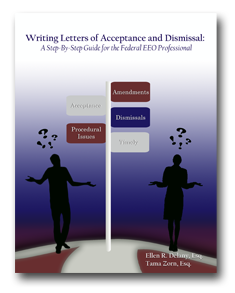
This book is for use by federal sector equal employment opportunity (EEO) professionals, including EEO specialists, EEO Directors, or agency attorneys, who carry out the mandates of the federal sector EEO program related to the formal EEO complaint process. For both the agency and the complainant, the first critical step in the formal EEO complaint process is the agency's decision whether to accept and investigate the discrimination issues identified during informal counseling and in the formal EEO complaint. An equally important step is the agency's identification and analysis of EEO issues that it prepares to dismiss, in whole or part. These key agency decisions are communicated to the complainant through an agency letter of acceptance (LOA) or an agency dismissal.

The underlying assumption of this book is that an analytical framework is essential for a full understanding of the varied requirements and complexities in drafting LOAs and dismissals. The goal of this book is to help you develop a workable, analytical framework that includes a review of all key procedural and substantive standards for preparing timely and complete LOAs, and defensible dismissals. Your use of this book will enable you to preserve the rights of all parties during the formal EEO complaint process, while maintaining your commitment to the underlying integrity of the EEO complaint process.

The book is not an exhaustive source of all Commission or federal court cases that arise under the federal sector EEO complaint process; there are simply too many cases to use such an approach. Accordingly, this book is not a substitute for consistent analytic reading, research, and reference to additional relevant material such as the Commission's regulations at 29 C.F.R. Part 1614 and Management Directive (MD) 110 (revised as of November 9, 1999). This information is now available on the Commission's website at www.eeoc.gov.

We have developed the materials in this book for both self-guided study and facilitated training on how to draft an LOA or dismissal. If you use this book for individual study or as an ongoing desk guide after attending training, we have outlined the critical acceptance and/or dismissal steps in practical and easy-to-follow checklists.

To assist you in developing a systematic analytic framework, each substantive chapter includes:

  1. A description of each key regulatory provision, e.g., 29 C.F.R. § § 1614.107(a)(1)-(9);
  2. A summary analysis of the underlying purposes for each regulation or dismissal provision;
  3. A brief illustrative case study;
  4. A review and analysis of the key procedural and substantive dismissal standards as applied to the case study;
  5. A checklist of key findings for each potential dismissal;
  6. A description of significant practice tips; and
  7. A list of selected pertinent Commission and court decisions. This list is not exhaustive, but is included to illustrate how the Commission and federal courts have recently interpreted and applied key procedural and substantive standards.

In Chapter 2,"Overview of the Federal Sector Complaint Acceptance and Dismissal Process," we describe and analyze the multiple purposes of an agency letter of acknowledgment and/or LOA. We also review an EEO professional's critical roles and responsibilities when preparing a LOA or dismissal. A careful examination and understanding of these responsibilities will ensure that the EEO professional's activities are consistent with and further the underlying integrity of the agency's EEO complaint process.

Chapter 3, "The Building Blocks for Federal Sector Equal Employment Opportunity," describes the analytical and conceptual foundation on which the EEO professional "accepts" or "dismisses" potential EEO issues. These building blocks include: (1) the federal statutory and regulatory provisions that define prohibited behavior in the workplace, i.e., discriminatory bases; and (2) the theories of discrimination and standards of proof applicable to the federal sector EEO complaint process. We believe that a review of these building blocks will ensure that EEO professionals prepare LOAS or dismissal that meet all requisite substantive and procedural criteria, and further the integrity and fundamental fairness of the agency's EEO complaint process.

Chapter 4, "Five Key Changes to the Federal Sector EEO Complaint Dismissal Process," reviews the significant changes to the federal sector EEO complaint dismissal provisions adopted by the Commission, effective November 9, 1999. We have analyzed these changes in detail, because the Commission adopted them to improve the fairness, efficiency and effectiveness of the federal sector EEO complaint process.

These regulatory changes authorize an agency to dismiss: (1) a complaint alleging dissatisfaction with an agency's processing of a previously filed complaint, a so-called "spin-off" complaint; and (2) a complaint filed to abuse or misuse the federal sector EEO complaint process. The new regulations also rescind an agency's authority to dismiss a complaint when a complainant failed to accept a timely, certified offer of full relief. In place of the "full relief" dismissal provision, the Commission now permits an agency to make an "offer of resolution" to encourage voluntary settlement before an Administrative Judge (AJ) hearing.

As part of its revisions, the Commission eliminated a complainant's right to immediately appeal an agency's partial dismissal, i.e., when the agency dismisses some but not all of the claims in a complaint. In addition, Commission Administrative Judges (AJs) are now authorized to dismiss a complaint during the hearing process for all of the reasons set out in 29 C.F.R. § 1614.107.

Chapter 5, "Expeditious Dismissals," analyzes the agency dismissals that are most frequently prepared by EEO professionals: (1) failure to state a claim; (2) failure to timely contact an EEO counselor; and (3) failure to timely file a complaint. In this chapter, we also review the standards for determining whether a complaint has successfully alleged a "continuing violation." These dismissals are important because they increase the efficiency of the federal sector EEO complaint process and help to preserve the integrity of an agency's EEO program and procedures.

In Chapter 6, "Dismissal Because the Complaint is Moot or Alleges a Proposal to Take a Personnel Action, or Other Preliminary Step to Taking a Personnel Action," we examine the Commission's standards for dismissing a complaint that does not allege a current harm or injury. These standards apply when a complaint is moot, i.e., events or actions taken after the agency's discriminatory acts have "removed" the harm or injury allegedly sustained by the complainant. In Chapter 6, we also review the dismissal criteria for a complaint alleging that an agency's proposal to take a personnel action, or other preliminary step, is discriminatory.

Chapter 7, "Dismissal Because the Complainant Has Used Other Resolution Processes," focuses on the standards for agency dismissals when the complainant has raised an EEO issue in a prior complaint, a district court complaint, or in a union grievance. These standards require an agency to dismiss a complaint when it: (1) states the same or identical claim that is pending before or has been decided by an agency or the Commission; (2) is the basis of a civil action that is pending in a federal district court; and/or (3) states an EEO matter that has already been raised in a negotiated grievance procedure. These dismissal provisions prevent the complainant from wasting limited agency resources, and avert the "potential for inconsistent or conflicting decisions."

Chapter 8, "Dismissal Because the Complainant Failed to Cooperate," analyzes the instances in which an agency can dismiss a complaint because the complainant has unreasonably failed to cooperate in the agency's EEO complaint process. In this chapter, we review the two circumstances in which the complainant's failure to cooperate will justify a dismissal: (1) when the agency cannot locate the complainant despite its reasonable efforts; and (2) when the complainant fails to respond to an agency's written request to provide additional relevant information or proceed timely with a complaint.

In Chapter 9, "Appeals Rights," we review the Commission's revisions to the time period for filing appeals, and the procedures for filing appeals to the Commission.

The assumptions governing our step-by-step guide are based on DSZ's systematic approach to analyzing EEO issues, an approach that we call "A.S.K.": what Attitudes, Skills and Knowledge do we need to make sound acceptance or dismissal decisions? EEO professionals must have appropriate attitudes, including a commitment to their roles as neutral evaluators and to the integrity of the federal sector EEO complaint process. Their necessary skills include the ability to write clear and concise prose, while prudently and reasonably analyzing the EEO issues raised in complaints and counseling reports. Their knowledge must include a comprehensive understanding of applicable federal statutes, regulations, the MD-110, and relevant Commission and court decisions.

We hope our step-by-step guide helps you to A.S.K. the right questions, and arrive at the best answers as you make key decisions during the formal EEO complaint process.